Autopilot playbooks: your trading rules, run for you
19 November 2026
How MUTEX playbooks turn indicators, filters and AI checks into a trading bot you build on a canvas, backtest on real history and let Autopilot run.
Most traders have rules. Buy the dip, but only while the trend is up. Cut the trade at 2%. Never chase a candle that is already at the high of the day. Writing the rules down is easy. Following them is the hard part: at 3am, on six markets at once, every hour, without flinching.
A MUTEX playbook follows them for you. You build your rules on a canvas from blocks: indicators, filters, logic and AI. You test them on real price history. Then Autopilot runs them on every candle close, in their own account, with the size and stops you set. No code, no server, no alerts to wire up.
Autopilot is the home in the MUTEX app for everything that trades on its own: AI agents you hire in plain words, and playbooks you build from your own rules. This post is about playbooks: what they are made of, how a signal becomes a trade, where the AI fits in, how to size and test one, and what happens once it runs.
Why build a playbook
- Rules that never sleep. A playbook checks its markets on every close of its timeframe, from every 5 minutes to once a day, around the clock.
- One rule, many markets. Point the same rule at up to 10 markets. Each market runs on its own line, and all of them share one account.
- AI where judgement helps. Add an AI step that reads the chart and checks each entry against your instruction, written in your own words. Or let it decide what to hold.
- Tested before it trades. One press backtests the whole playbook on real candles, AI steps included, after fees.
- Risk set in advance. Every entry carries its size, stop loss and take profit, worked out the moment it enters.
- Nothing hidden. Each step keeps notes on what it did and why, so you can see why a trade happened, or why it did not.
What a playbook is
A playbook is a small set of steps on a canvas, wired left to right. Each wire carries one kind of thing. Candles flow out of a Market step. A Signal flows out of the steps that decide when to go long, short or flat. Trades flow out of the Trade step to the steps that follow up on them. To connect two steps, you drag from one step’s right dot to the next one’s left dot.
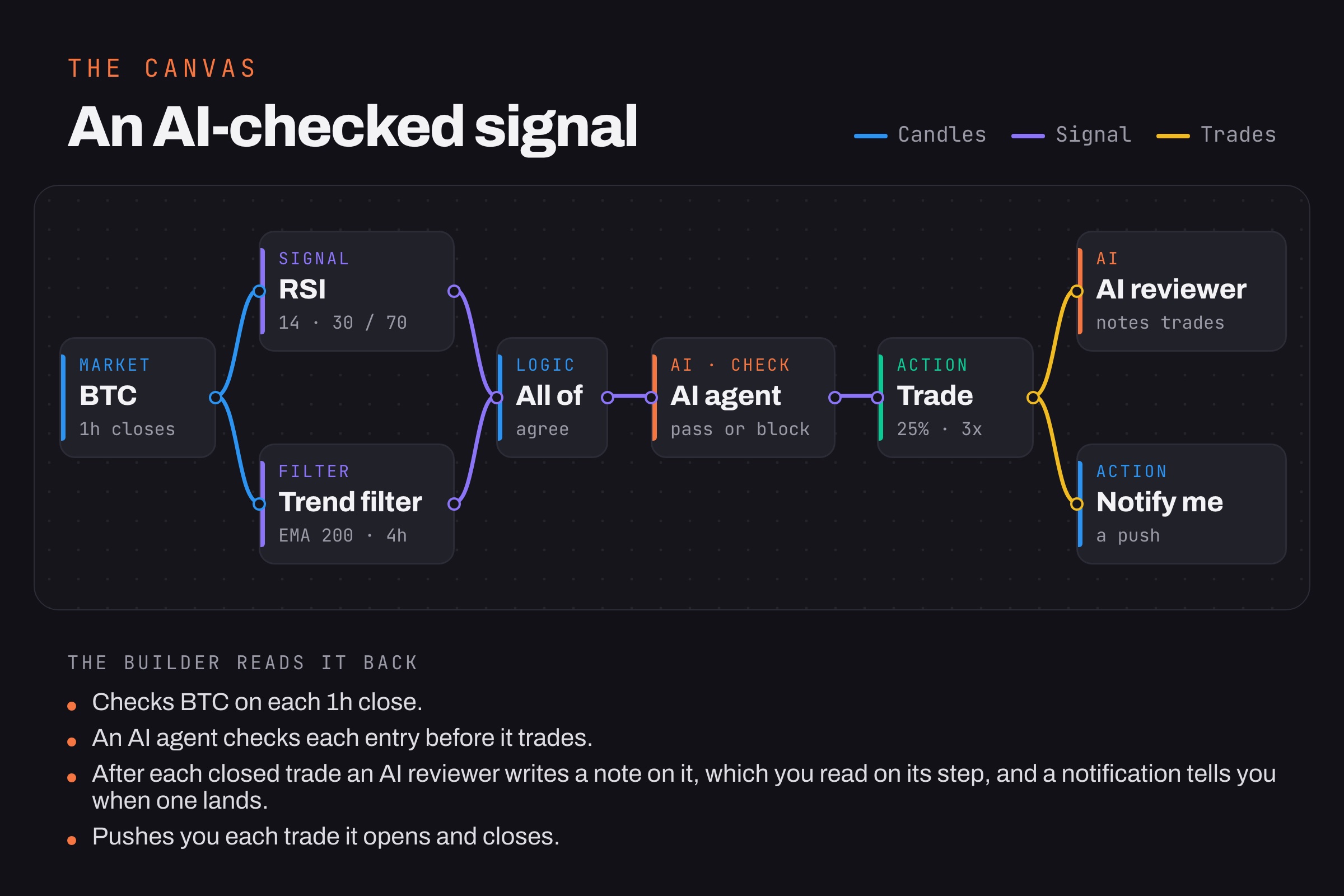
You never have to read a diagram to know what you built. The builder reads the playbook back to you in plain words as you change it, and it checks the wiring as you go: a step that is wired wrong is marked, and says what to fix. On a phone, where there is no canvas to drag on, you wire the same steps from lists.
You can start from a blank canvas or from one of three templates: Indicator, one indicator straight to a trade; AI-checked signal, the playbook above; and AI trader, an AI agent that reads the candles on each close and decides what to hold.
The building blocks
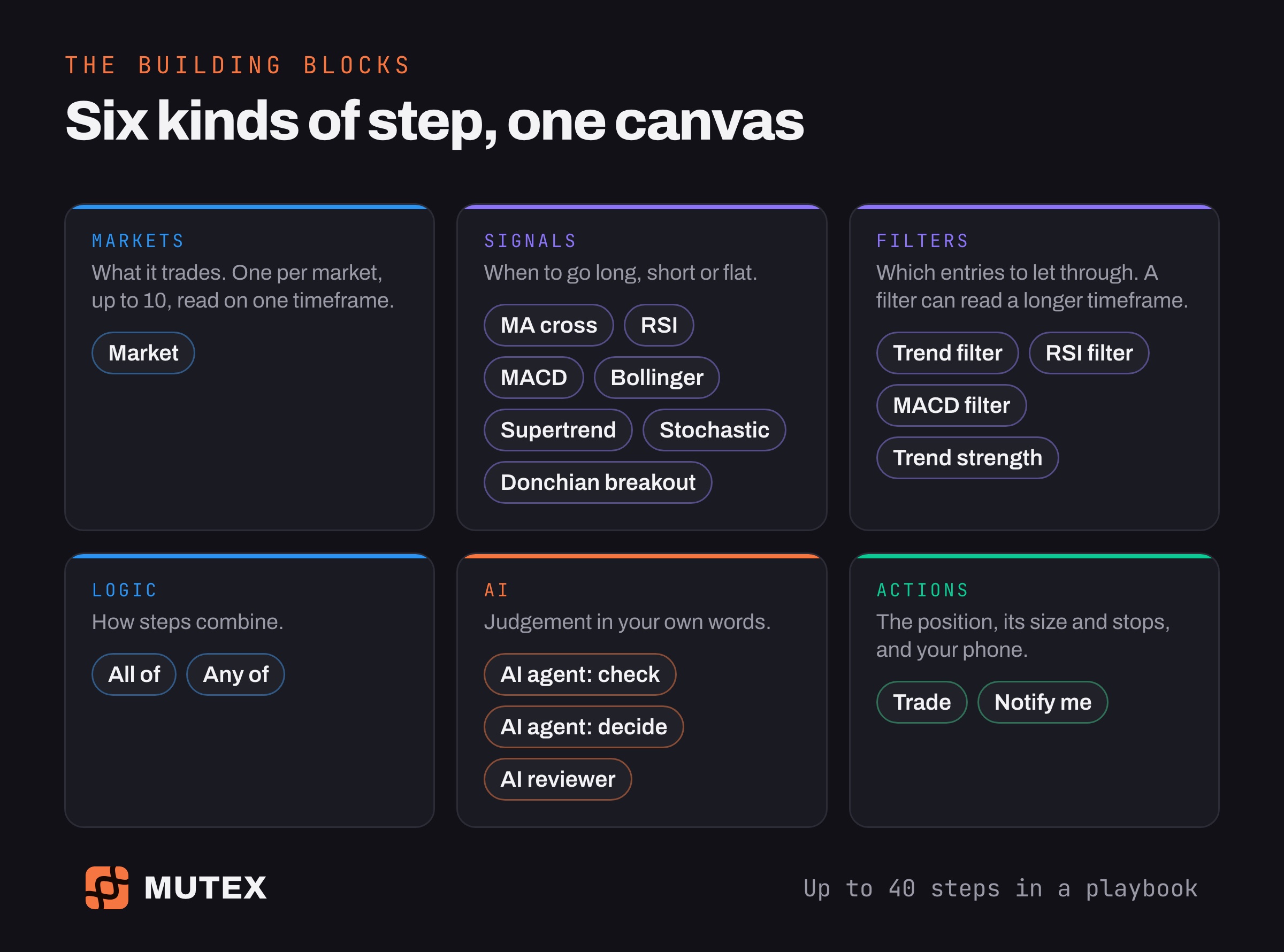
- Markets. One Market step per market, up to 10 in a playbook. A playbook trades either perps, long and short with leverage, or spot tokens, long only. All its markets read one timeframe: 5m, 15m, 1h, 4h or 1d on perps, and from 15m up on spot (from 1h for some tokens).
- Signals. Seven classic entries, each with the settings traders know: MA cross (on simple or exponential averages), RSI, MACD, Bollinger, Supertrend, Stochastic and the Donchian breakout. Each one says when to go long and when to go short.
- Filters. Rules that decide which entries get through. The Trend filter lets longs through only above an average and shorts only below it. The RSI filter and MACD filter do the same with momentum, and Trend strength lets entries through only when ADX says the market is trending. A filter can read a longer timeframe than the playbook, so an hourly playbook can buy only while the daily trend is up.
- Logic. All of lets a signal through only when every filter wired into it agrees. Any of passes signals that agree, and nothing when two disagree on the same candle.
- AI. The AI agent checks entries or decides what to hold, and the AI reviewer writes a note on every closed trade. More on both below.
- Actions. The Trade step holds the position the signal asks for, with its size and stops. Notify me sends a push to your phone each time the playbook opens or closes a trade.
How a signal becomes a trade
Take the playbook in the first picture. On every hourly close, the RSI step reads BTC. When RSI 14 climbs back above 30, it signals a long. When it falls back below 70, it signals a short. The Trend filter reads the 4-hour chart instead, and lets longs through only while BTC is above its 4-hour EMA 200, shorts only while it is below. All of passes the RSI signal only when the filter agrees.
Next, the AI agent sees the signal, the last 60 closed candles, and the RSI and EMA values that led to it. It lets the entry through or blocks it, following your instruction. If it passes, the Trade step opens the position with its size, stop loss and take profit. When that trade ends, the reviewer writes its note, and Notify me has already told you about the open and the close.
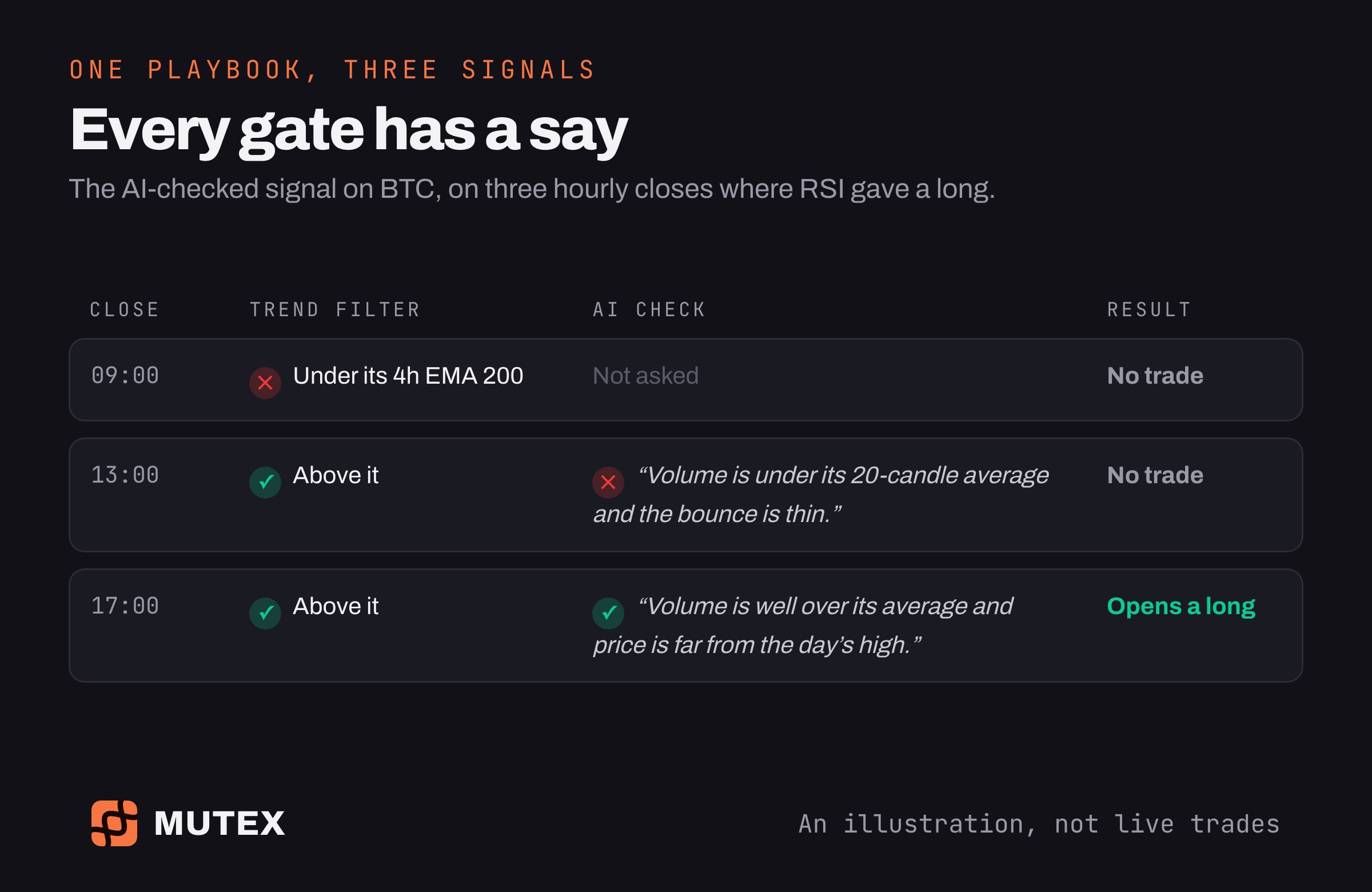
A position ends in one of two ways. Its stops or take profit close it, or the signal turns. In a playbook that trades both ways, a short signal closes the long and opens a short. Filters and AI checks only ever gate new entries, never exits, so a short that the filter blocks still closes the long. Set the Trade step to Long only, and a short signal simply closes the long and waits.
AI where you want it, and only there
AI is a step like any other. You decide whether a playbook has any, and exactly what each AI step is asked. A playbook can hold up to two AI agents and one reviewer, and each one follows an instruction you write in your own words, up to 2,000 characters.
Check each entry
An AI agent in check mode sits after your signal and is asked about every entry that reaches it. It answers pass or block, with one plain sentence saying why. The template’s instruction is:
Take the signal only if volume is above its 20-candle average and price is not pressing into the day’s high.
This is the AI as a second opinion. The rules do the finding, and the AI filters out the setups a rule cannot describe, the thin bounce or the breakout with no volume behind it.
Decide what to hold
In decide mode, the AI agent reads the candles on every close and answers long, short or flat. The playbook changes its position only when the answer changes. The AI trader template runs on 15-minute candles with this instruction:
Go long on higher lows, short on lower highs, stay flat in a range.
The Trade step still sizes every entry and sets its stops, and the same answer repeated does not undo a stop that has closed the trade.
Review every trade
The AI reviewer reads each trade after it closes, with its entry, exit, fees and the candles up to its exit, and writes you a short note. Its template instruction:
Say in two lines why the trade won or lost and whether the rule should change.
You read the notes on the reviewer’s step, and with Push on, a notification tells you each time one lands. The reviewer never changes your playbook. If you allow it, it can pause the playbook after a trade your instruction says should stop it.
The guardrails
- The AI never places an order. It only answers a question. Code places the orders, with the size and stops you set.
- It sees prices, not dates. Candles reach the AI as numbered rows with no dates or times, live and in a backtest alike, so it cannot answer from what it knows happened next. That keeps an AI backtest honest.
- It fails safe. If an answer has not come 5 minutes after a close, the call fails or the daily AI allowance is spent, a check blocks the entry and a decide keeps the position it had.
- There is no charge for the answers. Each account has a daily AI allowance, and the builder tells you when a backtest has used it up.
The Trade step: size and stops
Everything about the position lives on the Trade step:
- Direction: Both, Long only or Short only. Spot is long only.
- Size: a fixed position or margin in USD, a percentage of the balance or of the free money, or a risk size: the USD or the percentage of the balance that the trade loses if its stop is hit.
- Exits: a take profit and a stop loss in ticks, % of price, USD or % of the balance; a trailing stop that follows the best close since the entry; and an ATR stop that sets its distance from how much the market moves. When there are several stops, the tightest one wins.
- Leverage on perps, up to each market’s own limit.
Every size is worked out at the moment of entry, on the account as it stands then. A playbook that has grown stakes more on its next trade, and one in a drawdown stakes less. A risk size makes this precise:
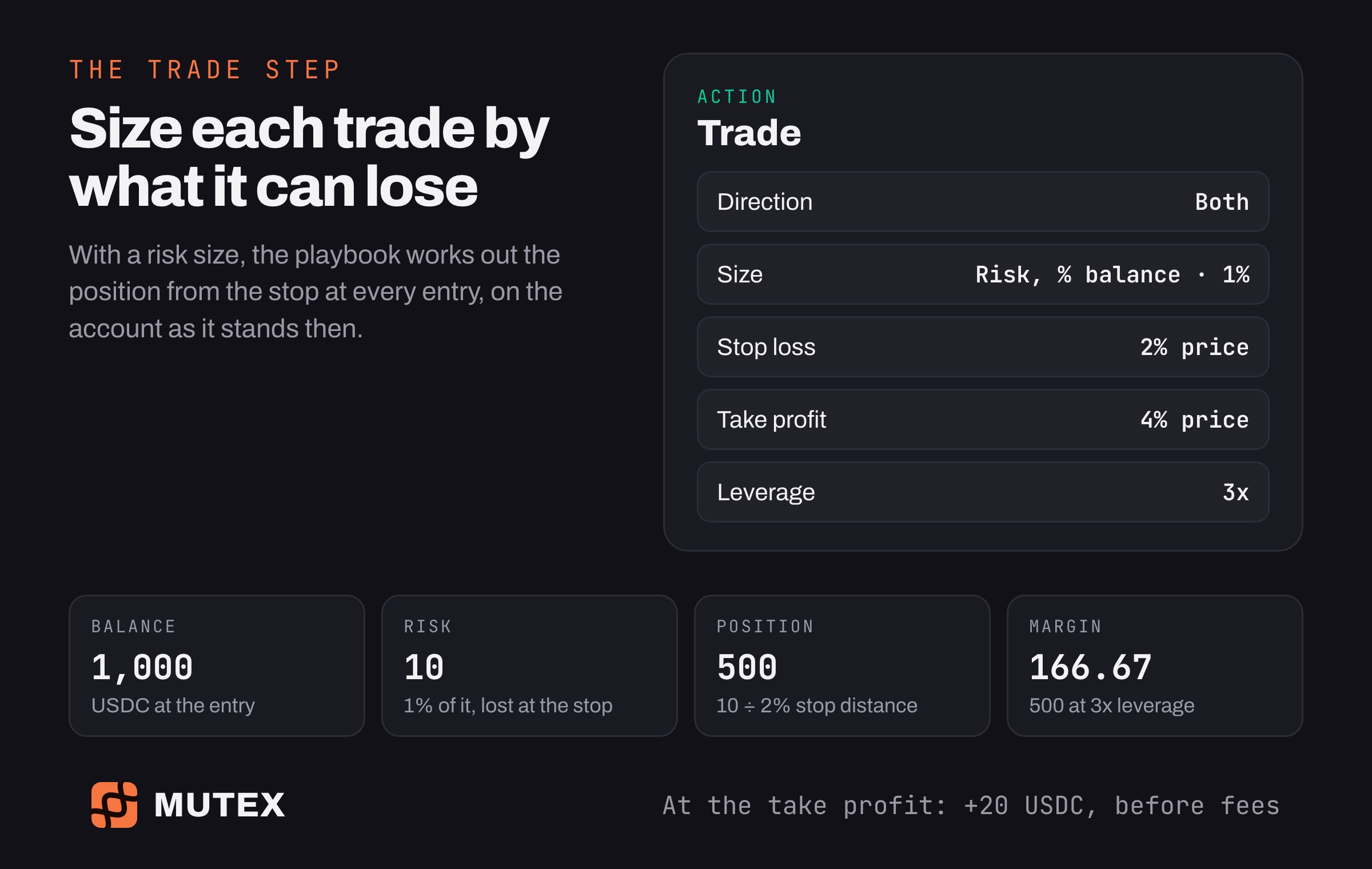
With 1,000 USDC in the account, a 1% risk is 10 USDC. The stop sits 2% from the entry, so the position is 500 USDC, which takes 166.67 USDC of margin at 3x. If the stop is hit, the trade loses 10 USDC plus fees. If the take profit is hit, it makes 20 USDC before fees. After a few wins take the balance to 1,200, the next trade risks 12.
A single entry never takes more than 90% of the free money on perps, or more than the cash on spot. An entry smaller than the market’s minimum order is skipped, and the Trade step’s notes say why.
Backtest before you fund it
Press Run backtest, and the playbook replays on the market’s real candles, step by step, with the same code the live run uses. The result is the whole account, across all its markets: the net return from your starting money to where it would have ended, the number of trades and how many won, the deepest drawdown, and what simply holding the market did over the same candles. Open a market to see every trade on its chart, marked where it went in and out.
The backtest leans conservative:
- Every trade pays its fees, on the way in and on the way out.
- A candle that reaches both the stop and the take profit is counted as the loss.
- A stop that the market opens past fills at that open, not at the stop.
- On perps, the account is liquidated when its margin runs out, as it would be live.
- Slippage is not modelled, and neither is funding on perps, which can go for or against you.
AI steps are never skipped in a backtest. Each one is asked exactly what it would have been asked live, candle by candle, and the bar shows from which day the AI was tested. Each answer is kept, so running the same backtest again costs nothing.
Start it in its own account
When the numbers look right, choose the account and the money. Every playbook trades in its own bot account: a new Perps account, for long and short with leverage, or a new Spot account, which holds tokens and buys long only. The smallest amount is currently 25 USDC. Your main balance stays out of the playbook’s reach.
Press Start, and MUTEX first checks the whole playbook the way the run will read it. If anything is wrong, no account opens and no money moves. If it is right, the account opens, the money goes in, and the playbook starts reading its markets. A playbook trades with its whole bot account, so a later deposit gives its next entries more to work with.
While Autopilot runs it
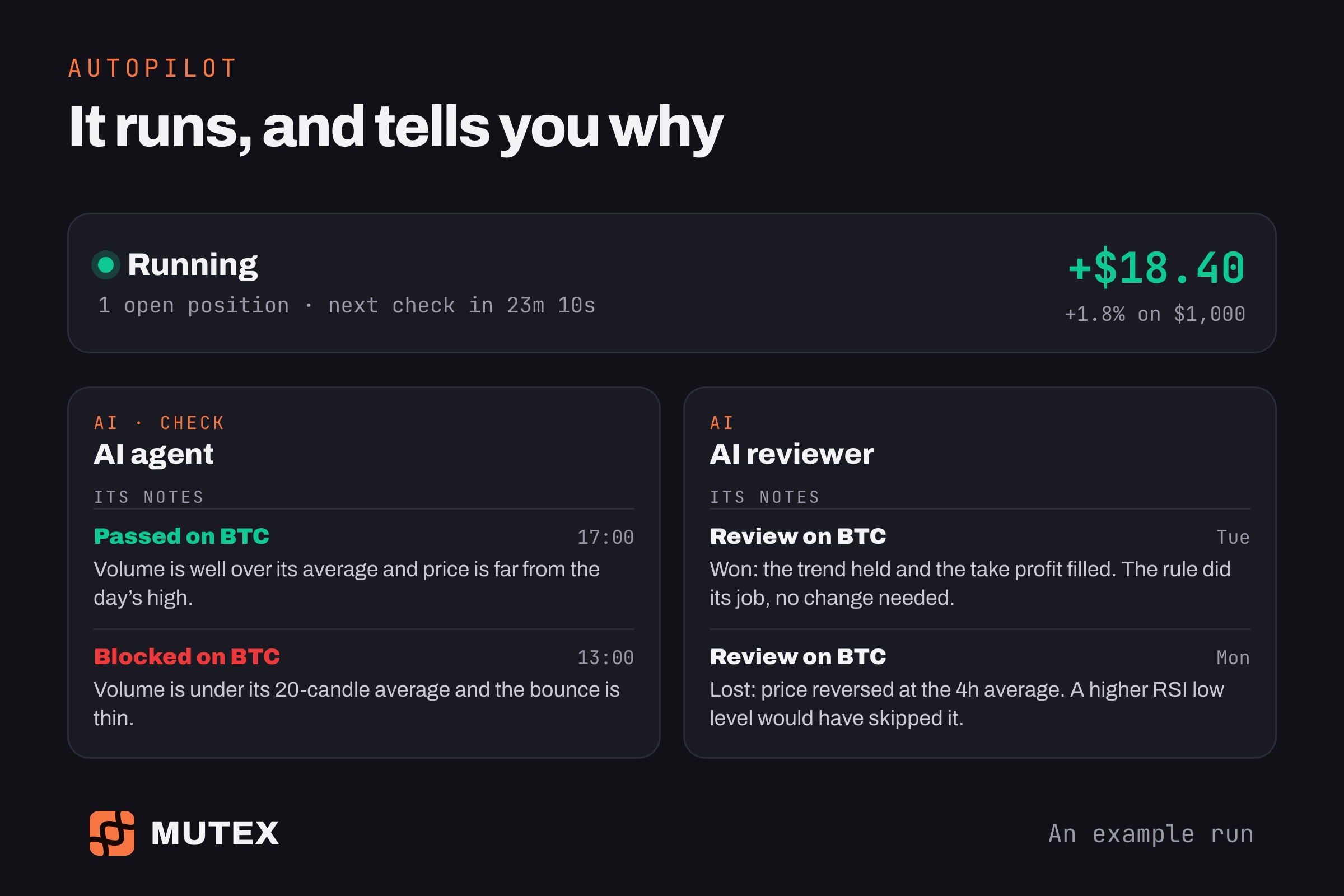
- You can see what it is doing. The playbook’s page counts down to its next check and shows its open positions. On perps it shows the P&L on the money you put in, after fees. On spot it shows the account’s value against the money you put in.
- You can see why. Click any step to read its notes: each AI answer and its reason, each entry the Trade step skipped and why, and each review.
- You can change it. Edit a step on a running playbook and save it, and the playbook trades the new version from the next candle close. You can rename it while it runs, and pause and resume it at any time.
- You can stop it. On perps, Stop cancels its orders and closes its positions. On spot, Stop sells the tokens the playbook bought. Either way the money stays in its bot account. A stopped playbook cannot start again, so to change course you build a new one.
Playbooks you could build today
A few rules that fit in a handful of steps, each one a playbook you can backtest before it holds a dollar.
Trend rider
BTC and ETH on 4-hour perps, wired into one MA cross on the 20 and 50 EMAs. All of lets an entry through only when Trend strength puts ADX 14 above 25, so the cross trades trends and sits out the chop. The Trade step goes both ways, risks 1% of the balance per trade, and sets its stop at two ATRs with a 5% trailing stop behind it.
Dip buyer
SOL on the spot desk, hourly. RSI 14 buys when it climbs back above 30, but only while a Trend filter puts SOL above its daily EMA 50. Long only, 20% of the cash per trade, a take profit 6% up and a stop 3% down. When RSI falls back below 70, the short signal sells the position.
Breakout basket
Five perps markets, daily candles, all wired into one Donchian breakout on 20 days. Each market runs on its own line, and the Trade step risks half a percent of the balance on each breakout, with a stop 5% from the entry. Five breakouts at once still risk about 2.5% of the balance in total.
AI-checked signal
The template from the top of this post: a classic signal in the direction of the bigger trend, with an AI check that applies your judgement, and a reviewer that tells you after every trade whether the rule is still working.
AI trader
One AI agent in decide mode on 15-minute candles, with an instruction in your own words, such as:
Hold long only while price makes higher lows. Go flat on the first lower low.
Give the Trade step an ATR stop, and the playbook keeps a hard limit on every trade, whatever the AI thinks.
What it costs
- No playbook fee. Building, backtesting and running a playbook costs nothing on its own.
- No charge for AI answers, within the daily AI allowance.
- Trading fees. A playbook’s orders pay the same fees as your own: the normal perps trading fees, or the spot desk fee on each swap, currently 0.5%.
- Free to fund and withdraw. Moving money in and out of a bot account costs nothing.
The fine print
- A backtest shows what the rules would have done on past candles, not what they will do. Live fills can differ through slippage, and on perps through funding.
- On perps, a playbook trades with leverage, so a sharp move can liquidate its bot account and lose what is in it. Only that account is at risk, never your main balance.
- The AI can be wrong. That is why it never places orders, why every entry carries the stops you set, and why it fails safe when it does not answer.
- You can currently run up to 5 perps bot accounts and 5 spot bot accounts, shared with MUTEX Bots, and each runs one playbook or bot at a time.
Get started
Open Autopilot in the MUTEX app and choose Build a playbook. Start from a template or a blank canvas, wire your rules, and run the backtest until you trust what you see. Then fund it, press Start, and let Autopilot take the next close. If you would rather describe what you want and let an AI trade it, hire an AI agent from the same page.